St Catherine's Parish History
Acknowledgement...................... The basis of much of this short Parish History is the "History for the Golden Jubilee of St Catherine Labouré" written by parishioner Amy Dugdale in 1997 to celebrate the 50th Anniversary of the founding of the Parish.
ST CATHERINE LABOURÉ
St. Catherine Labouré was born in France on May 2, 1806 as the ninth of 11 children to Pierre and Madeleine Labouré. In 1815, Catherine's mother passed away, leaving her 9yearold daughter with the responsibility of caring for the household. After her mother's funeral, Catherine returned home and picked up a statue of the Blessed Virgin. Holding it close, she said, "Now you will be my mother." Growing up, Catherine was known for being a quiet and practical child, though she was extremely devout. A couple of years after her mother's death, Catherine experienced a dream of an old priest motioning her to a room of sick people. "It is a good deed to look after the sick. God has designs on you. Do not forget it." Years later, during a visit to the Daughters of Charity hospital, Catherine saw a picture of the old priest on the wall. She discovered it was of their founder, St. Vincent de Paul. Catherine immediately knew she would become a member of St. Vincent's order.
In January 1830, Catherine Labouré entered the novitiate of the Daughters of Charity. Months later, on July 19, 1830, Catherine woke from her sleep after hearing a child's voice calling her to the chapel as the Blessed Virgin Mary was waiting for her. As Catherine approached the chapel, the door swung open revealing a brilliant light. The Blessed Virgin told Catherine she would be given a mission with all the graces necessary to complete it. Our Lady said, "God wishes to charge you with a mission. You will be contradicted, but do not fear; you will have the grace to do what is necessary. Tell your spiritual director all that passes within you. Times are evil in France and in the world."
In November 1830, the Blessed Mother visited Catherine a second time during evening meditations. She showed herself inside an oval frame, standing upon a globe with rays of light coming from her hands toward the globe. Around the frame were the words, "O Mary, conceived without sin, pray for us who have recourse to thee." Mary asked Catherine to take these images to her father confessor, Father Jean Marie Aladel, telling him they should be placed on medallions. "All who wear them will receive great graces." At first, the priest did not believe Catherine, but after two years, he brought her story to the Archbishop. The Archbishop ordered 2,000 medals struck. The medals were dispersed so rapidly and effectively it was said to be miraculous.
Catherine Labouré spent the next 40 years of her life caring for the elderly, sick and disabled. On December 31, 1876, Catherine passed away at 70yearsold. Her body was encased in glass beneath the side altar in the Chapel of Our Lady of the Miraculous Medal in Paris. Her body was discovered to be incorrupt after being exhumed in 1933. She was beatified by Pope Pius XI on May 28, 1933 and canonized by Pope Pius XII on July 27, 1947. St. Catherine Labouré is often shown with the Daughters of Charity habit and the Miraculous Medal. St. Catherine Labouré is the patron saint of the elderly, infirm people and the Miraculous Medal. Her feast day is celebrated on November 28.
A BRIEF HISTORY OF THE PARISH OF ST CATHERINE LABOURÉ
The Catholic history of Leyland is rooted in Lancashire's strong tradition of recusancy followed by the arrival of the Benedictines in the 19th century. In the Tudor and Stuart Eras Chorley and Leyland retained a high proportion of Catholics due to committed local gentry and hidden seminary priests who ministered secretly.
The Benedictine monks came to Leyland and founded the parish of St Mary’s in 1845 and, after using temporary chapels for several years, the first Church of St Mary’s was built on Worden Lane in 1854. At the time of the restoration of the Catholic hierarchy in 1850, therefore (and, indeed until 2022), St Mary’s was a Benedictine parish served by monks from Ampleforth Abbey, albeit part of the Liverpool Archdiocese.
In the mid 19th century the Catholics of Leyland numbered perhaps a few score, and at the turn of the century, this number had grown to around 500. The further development of heavy industry in Leyland caused it to change, over time, from a quiet agricultural village into a busy industrial town with an increasing number of Catholics, and despite an enlargement of the original church in 1919, this was not enough to accommodate the post-WW2 Catholic population. At that time Father Anselm Parker, Parish Priest of St. Mary's, Leyland and was a man of great foresight, and he must have realised that in the very near future another church would have to be built. When the house and land on which St. Catherine's now stands came on sale, it must have seemed like an answer to a prayer. A church built there would be able to take care of all the Catholics of the northern end of the town, and thus relieve the situation. The precise date of the land purchase is not known, but it is likely to have been in early 1946. It seems strange, surrounded as we were by Benedictine parishes, namely St. Mary's Leyland, Our Lady and St Gerard's at Lostock Hall, St Mary's, Brownedge, and St. Joseph's, Brindle, and considering that a Benedictine was instrumental in buying the land; that St. Catherine's was not itself a Benedictine parish. It is believed that, because St. Catherine's was built on territory which belonged to Ampleforth, the Abbot at that time must have given permission for the setting up there of a new parish, he must also have allowed the Archdiocese to buy the land.
It obviously took some considerable time to agree, plan and execute the necessary arrangements to facilitate the new Parish but, finally, on 7th October 1947, the first Parish Priest Father Joseph Burke arrived in Farington, but as the house on the site was tenanted, lodgings were found for him on Stanifield Lane.
The very first event to take place after Father Burke's arrival was a social evening which was held in a room over the Rose and Crown hotel where discussions were held about ways and means of raising money. The first decision taken was to use the garages on the land. These were well-built brick buildings, which could be converted for use as a small and basic church. A great deal of work went into converting the garages and while this was going on, Masses were held in the chapel of the Poor Clares' convent.
When the garage-church was completed, the consecration ceremony took place in March 1948. The entrance was by the sacristy door, with another door opening on to where the altar was later situated, from 1949. The original altar was a small one on the wall, and was given to us by Ss. Peter and Paul's in Liverpool. The space occupied by the congregation was very small, and one realised that even with three full masses, we still had only a very small number of people to start a parish.
Father Burke was now in his house, we had a small church in which to celebrate mass; now we had to face the challenge of building a new church.
THE HUT
Father Burke bought a building that consisted of concrete blocks, bolted together, which was in fact army surplus material, and this was erected behind the church. This was probably bought between the consecration of the garage church in March 1948 and the laying of the foundation stone for the new church in October the same year.
As soon as alterations to the “garage church” began (during which part of one of the walls of the garage church was demolished, and the opening left was the arch in front of the present altar), the venue for masses switched to the "Hut". It was very basic, and for quite a while had only a cinder floor.
Soon after the opening of the new church in June 1949 Father Burke applied for a drinks licence, so that we could use the Hut as a licensed club. Father Burke's idea for turning the Hut into a club was not universally popular; indeed many older parishioners did not approve at all. However, Father Burke had his way, and St. Catherine's now had a licensed club!
The club was popular for a time, but Father Higgins, who never approved of it, later allowed the licence to lapse. After that the Hut was little used, as we had the hall in which to hold events and it deteriorated so badly that it was demolished, possibly in Father Moroney's time.
BUILDING OF THE CHURCH
At the time of the building of St. Catherine's, Britain was in the process of recovering from the Second World War. Bombed areas were at the top of the priorities lists; hospitals, schools, docks, roads and railways all had to be restored. The country was bankrupt, everything purchased had to be covered by ration books, coupons, dockets or permits. No-one was allowed to build anything unless permission was granted. Not the most auspicious situation to be in!
As Father Burke battled his way through all the paperwork, he discovered that he would not be allowed to build a church, but he could extend on an existing building. This is how the body of the little garage church became the altar, and the main body of the church was added on.
Pews, even if they had been affordable, were unobtainable, so Father Burke bought a lot of wooden chairs, and these were joined together in fours. In the meantime, things were steadily becoming worse, and finding building materials was like finding gold, so it fortunate that Father Burke had a great many influential friends in Liverpool, in all walks of life - some helped him to get hold of materials which were almost impossible to obtain, others helped him to cut through loads of red tape.
Large sliding doors (wooden) were built over the altar, so that when closed, the body of the church could be used for any entertainment, or for any fund-raising events. A kitchen was built with a hatch through which refreshments could be served when a social event was taking place.
Everyone in the parish, and even some from surrounding parishes, joined in and worked so hard, helping in any capacity they could. For the parishioners, and everyone who had helped, it was a
joyful and proud day when the church was opened in June 1949.
St Catherine’s – newly built St Catherine’s – original Altar
Archbishop Richard Downey officiated at the opening, a temporary altar was erected in the grounds, and mass was said in the open air, in order that more people could attend. The Archbishop congratulated Father Burke on all the work he had done, and on overcoming all the difficulties he had had to face.
The church was dedicated to St Catherine Labouré, and was the first to be dedicated to this saint. She was canonised in July 1947, only three months before Father Burke's arrival in Farington to start the new parish.
We now leap forward in time by nearly 50 years to 1996…..
By 1996 all the electrical equipment in the church was in a very bad state. It had been in use for almost fifty years, having been installed in 1948-49. It was approaching the point of being dangerous, and it became obvious that the parish would soon have to approach the Archdiocese for a loan to cover the cost of these crucial repairs. At the same time it was thought that perhaps we could persuade the Archdiocese to lend a little extra to have the church remodelled and refurbished at the same time as all the upheaval took place for the electrics. Initially this proposition was rejected but a series of fund-raising initiatives eventually resulted in our gaining permission to go ahead with the re-modelling of the church!
On 5 January 1998, Sunday, the last mass was said in the old church, and on 6 January the builders moved in to start the work. While the church was closed, masses were held on Monday, Tuesday, Wednesday, Thursday and Saturday at Mrs Dugdale's property, on Fridays in the presbytery, and on Sundays in the school hall.
Things went very smoothly, and the Church was re-opened on Sunday 28 April 1998. The effect on entering the church was breathtaking. It was so different, so bright and colourful and beautiful. Everything was completely changed around, the altar was now at the northern end of the church where the entrance had been originally, and the entrance was now at the southern end.
An outside porch had been added to the building. The old sacristy and the adjacent lobby had been knocked into one, thus providing us with a large porch for notices, newspapers and any other business. The wall between the former entrance doors had been knocked down, the space to the outer wall incorporated to make space for the altar. The wooden background to the altar from the old church was preserved and made to fit as a background to the new altar. The new altar, lectern and a small credence table are all made in yew, beautifully designed and made by Les Grace of Burscough.
The window above the present altar was replaced by a stained-glass window, with the Holy Spirit, represented as a dove, in the centre. This was made by Father Charles Norris, an 88-year-old monk at Buckfast Abbey. Much of the money for this window was collected by the children of St Catherine's Primary School, and in recognition of this it is to be known as The Children's Window. A long, narrow window in the porch was also replaced by another stained-glass collection by Father Norris, representing the Tree of Jesse.
The Stations of the Cross and the pews, renovated and polished, came from St Patrick's church at Widnes. The Christening Font was made in Italy, of Carrera Marble; it was formed in the shape of a chalice. The ornamental candlestick was made at Worden Park, and was bought with money donated by the Knights of St Columba. A wall had been built at the back of the church, where the front of the old altar stood, with large double doors in the centre.
Any parishioner of old going into the meeting-room from the porch will think the wheel has turned full-circle. The meeting-room, which is where the old altar was, was in fact the original old garage, where we began saying masses fifty years before.
St Catherine’s – 2025 St Catherine’s interior – 2025
THE END OF AN ERA…… AND A NEW PARISH!
So – we come forward in time to the present day and changes in demographics, population and religious observance alongside an aging cohort of priests and an ever-rising cost of property maintenance led to difficult decisions for the Archdiocese, resulting in a mix of church closures, parish amalgamation and shared priests. In St Catherine’s case we know that the result was the creation of the new parish and the closure of St Catherine’s church in 2025.
On 5th September 2025 a beautiful Mass of Thanksgiving was celebrated by Archbishop John Sherrington at St Catherine’s as we said farewell to our little church at Farington. It was a poignant evening and more than a few tears were shed.
Reproduced below are photographs that capture the occasion (thanks to David Barton for these) and also a copy of the Mass Sheet booklet prepared for the evening.


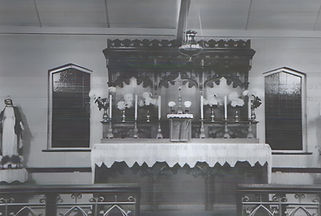


 Our little church in all it's glory. Farington's hidden gem! |  Awaiting the start of Mass. |
|---|---|
 Visiting concelebrants, including one former priest of the parish, Fr Raphael. |  Archbishop John entered to Elgar's "Ecce Sacerdos Magnus". |
 Incensing the altar. |  The smoke of the incense ascends as does the prayer of the saints before the Throne of God: Et ascendit fumus incensorum de orationibus sanctorum de manu Angeli coram Deo |
 The Scriptures proclaimed. |  Proclaiming the Gospel. The whole point of a parish! |
 Archbishop John. |  Our singers - mainly from the Octavius Choir, who have sung so beautifully over the years in our little church. Especially recalling our Charity Carol concerts for the Order of St Lazarus each year. They will continue at St Mary's, Euxton. |
 Always good to have an enthusiastic Music Director! |  The flag of the Order of St Lazarus in Great Britain. We have held many Order events at St Catherine's over the years, as Fr Simon is the Chaplain General for Great Britain. |
 Grand Chancellor of the Order of St Lazarus, His Excellency, Matthew Jackson, representing the Grand Master, HRH Prince Francois d’Orleans. Sitting with the concelebrating clergy. |  New experience for two of our younger newly recruited servers to wear the vimps. |
 Fr Simon is not singing solo here but saying a few words at the end of Mass. |  Thanks to Archbishop John for his words of consolation and of hope for the future. |
 Thanks to the Chancellor of the Archdiocese, Fr Sean Riley, acting as MC for the Archbishop. |  Our own St Catherine. She is preparing to move to her new home at St Mary's, Euxton. |
 At the end of Mass, the Blessed Sacrament was removed in solemn procession whilst the choir sang Allegri's Divine Praises; after which the people were invited to make a special final farewell to the church by coming up to venerate the altar with a kiss. |  Exuent omnes - to "Faith of our Fathers". We will be true to thee till death. |
 The sanctuary party. |
Click on this image to read the St Catherine's Celebration Mass booklet >>>>>>>>>>>>>>>>

RELIGIOUS COMMUNITIES IN THE PARISH ST CATHERINE LABOURÉ
SISTERS OF THE POOR CLARES
The Sisters of the Poor Clares, an austere order of nuns, bought the property of Moss House during the war in November 1940. The Poor Clares were an enclosed order, though they had two “external sisters” who did the shopping and other tasks for the Community.
The Poor Clares led a simple life – no central heating or carpeted floors in those days! Their spartan rooms were called cells and the windows had opaque glass. They wore sandals, but most of the time indoors they went barefoot. They never appeared in public, and even when their chapel was being used by the Parish during the preparation of the little “garage church” they were always behind a grille at Mass.
Those who knew them testified to their complete happiness.
With vocations declining, and the age of the sisters steadily advancing, it was decided that they should unite with their community at Arundel, and Moss House was acquired by the Order of Our Lady of the Missions in 1958.
SISTERS OF OUR LADY OF THE MISSIONS
After the Second World War, the Sisters of Our Lady of the Missions were keen to spread their wings to the North West of England and, with the intention of opening a Convent school in Leyland, they approached Fr Parker (St Mary’s Parish Priest) to help. Following a protracted and somewhat topsy-turvy process they acquired the property of Oaklands, close to the Poor Clares’ convent in Moss Lane.
Fr Parker celebrated the first Mass at Oaklands on 8th December 1948. The ground floor of the house was used as a school and the Sisters occupied the first floor. Between 1952 and 1956 the Sisters of Our Lady of the Missions built the Infant and Junior school – which operated as a private school until 1968 when it became state-aided.
In 1958 the Sisters of Our Lady of the Missions took possession of the Poor Clare convent and it became known as the Convent of the Sisters of Our Lady of the Missions (St Catherine’s) – Oaklands was then used as an annex to the school.
Alongside the primary school, for a number of years “Oaklands” functioned as a private Secondary school – known as St Catherine’s Secondary School, Oaklands, catering for both day pupils and boarders. The secondary school closed in 1966, due mainly to the changes in educational policy for Secondary Education in Lancashire.
The convent building remained home to the Order of nuns for decades (with roughly 135 nuns residing there over its history), until the community finally closed in February 2016 as numbers dwindled. A Mass of Thanksgiving and Celebration for the 68 years of presence and ministry took place at St Mary’s, Leyland on February 5th 2016.
St Catherine - Pray for us!
